
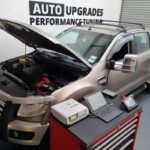
Ford Ranger PX1 Performance Tuning
The Ford Ranger PX1 established the foundation for what would become one of New Zealand’s most popular and capable utes. Strong, dependable, and designed for real work, the PX1 Ranger earned its reputation through durability rather than outright performance. What many owners discover, however, is that the factory ECU calibration leaves the engine feeling restrained, particularly at low engine speeds and under load.
This Ford Ranger PX1 belongs to Mohammed, and it was not the first Ranger we had tuned for him. After experiencing the improvements delivered by our PX2 Ranger performance tuning, he wanted to see what could be achieved with his earlier PX1 model. The objective was clear: improve torque delivery, throttle response, and overall drivability while preserving the reliability the Ranger is known for.
Why the PX1 Feels Held Back from the Factory
Like many globally sold vehicles, the Ranger PX1 is delivered with conservative ECU software. Ford’s factory calibration must account for a wide range of emissions regulations, fuel qualities, operating environments, and drivetrain protection strategies. That global compromise inevitably softens throttle response and delays torque delivery.
For New Zealand conditions, particularly towing, carrying load, or driving on open roads, this results in an engine that feels capable but hesitant. The hardware is willing. The calibration is simply cautious.
Unlocking the Potential of the PX1 Ranger
Ford Ranger PX1 performance tuning begins with a complete ECU read and structured software analysis. Key areas reviewed include fuelling strategy, boost control, torque request modelling, and transient response behaviour. Calibration changes are applied within the factory control framework rather than by bypassing systems.
For the PX1 3.2 TDCi engine, the focus is accurate torque delivery. By refining how torque is requested and limited, the engine becomes more responsive without increasing mechanical stress. Boost builds earlier and more smoothly, throttle input produces predictable response, and the engine operates closer to its optimal efficiency range.
How the PX1 Drives After Calibration
Once calibrated, the transformation is immediately noticeable. Low-speed acceleration is stronger and more decisive, with torque arriving earlier in the rev range. Throttle response is sharper without becoming abrupt, making the vehicle easier to drive smoothly in both urban and off-road conditions.
Mid-range performance is significantly improved. Overtaking requires less planning, hills are climbed with greater confidence, and towing becomes noticeably more relaxed. The Ranger holds gears more consistently and no longer feels like it is working harder than necessary.
Consistency Across Ranger Generations
Mohammed’s experience tuning both a PX1 and PX2 Ranger highlights an important point. While the platforms differ, the underlying calibration philosophy remains the same. Conservative factory software masks the true capability of the drivetrain, and disciplined ECU calibration restores it.
His PX1 now mirrors the drivability improvements he enjoyed in his PX2. Both vehicles benefit from the same engineering principles: accurate torque modelling, controlled boost delivery, and smooth, linear response.
Efficiency and Reliability Preserved
Improved performance does not come at the expense of efficiency. By delivering torque earlier and more predictably, less throttle input is required during normal driving. Many PX1 owners report improved fuel economy, particularly during highway cruising and towing.
Just as importantly, reliability is maintained. The calibration respects factory temperature limits, boost monitoring, and torque protection strategies. The engine continues to operate well within its design envelope, preserving long-term durability.
OEM-Level Calibration, No Compromises
Calibration Scope and Validation
Every Ford Ranger PX1 calibration begins with a verified baseline read of the factory ECU software. Calibration work then focuses on fuelling strategy, boost control, torque modelling, and transient response. All changes are made within the original ECU architecture.
Once calibration work is complete, the vehicle is validated through controlled road testing under New Zealand conditions. Cold start behaviour, part-load operation, towing response, and sustained highway driving are assessed to confirm consistency and drivability. Calibration is revised where required until behaviour meets expectations.
All factory safety systems remain fully active, including knock protection, torque and boost monitoring, and thermal management. The result is a Ranger PX1 that feels stronger, smoother, and more capable without compromising dependability.
Available Now
If your Ford Ranger PX1 feels capable but restrained, this performance tuning solution unlocks its full potential. Expect stronger low-end torque, sharper throttle response, and greater confidence when towing or overtaking, all delivered with OEM-grade calibration discipline.