
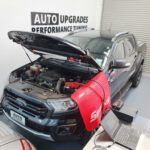
Ford Ranger 3.2 TDCi Performance Tuning
The Ford Ranger 3.2 TDCi has earned its reputation as one of New Zealand’s most capable and durable utes. Strong, dependable, and well suited to towing and off-road work, it is a platform designed to work hard. What many owners discover, however, is that the factory ECU calibration leaves the engine feeling restrained, particularly at low engine speeds and under load.
This 2015 Ford Ranger 3.2 TDCi arrived at AutoUpgrades with exactly that complaint. Despite its size and capability, the vehicle felt slow to respond off the line, hesitant when overtaking, and underwhelming when towing. The objective was not to chase numbers, but to deliver stronger, earlier torque and a more confident, predictable driving experience.
Why the Factory Calibration Feels Restrained
The 3.2-litre five-cylinder turbo-diesel is an inherently strong engine with excellent thermal capacity and mechanical robustness. From the factory, however, Ford calibrates the ECU conservatively to accommodate global emissions requirements, fuel quality variation, and drivetrain protection across multiple markets.
That conservative approach limits torque delivery at low and mid engine speeds, softens throttle response, and delays boost onset. For New Zealand conditions, particularly when towing or carrying load, this results in an engine that feels capable but muted.
Precision Calibration for the 3.2 TDCi
Ford Ranger 3.2 TDCi performance tuning begins with a full ECU read and structured data analysis. Key areas include injection timing, boost control, torque request modelling, and transient response behaviour. Calibration changes are applied within the factory control framework rather than by bypassing systems.
The focus is accurate torque modelling. By refining how torque is requested, delivered, and limited, the engine becomes more responsive without increasing mechanical stress. Boost builds earlier and more cleanly, throttle input produces immediate and predictable response, and the engine operates closer to its optimal efficiency range.
How the Ranger Drives After Calibration
Once calibrated, the transformation is immediately apparent. Acceleration from low speed is stronger and more decisive, with torque arriving earlier in the rev range. Throttle response is crisp without becoming abrupt, making the vehicle easier to drive smoothly in traffic and off-road conditions.
When towing, the difference is even more pronounced. The Ranger holds gears more confidently, pulls through hills with less effort, and requires fewer downshifts under load. The engine feels composed and controlled rather than strained, which is exactly how a working ute should behave.
Real-World Feedback
After driving the vehicle post-calibration, the owner described the improvement as immediately noticeable. The engine felt stronger, more responsive, and far better suited to everyday use. The hesitation present in the factory calibration was gone, replaced by smooth, confident torque delivery.
That feedback mirrors what we consistently hear from Ranger owners. The 3.2 TDCi is an excellent engine, but its factory software restricts performance to meet broad global targets rather than real-world use.
Efficiency and Reliability Preserved
Improved torque delivery does not come at the expense of efficiency. By delivering torque earlier and more predictably, less throttle input is required during normal driving. Many owners report improved fuel economy, particularly when towing or driving at highway speeds.
Just as importantly, reliability is preserved. The calibration respects factory temperature limits, boost monitoring, and torque protection strategies. The engine continues to operate well within its design envelope.
OEM-Level Calibration, No Compromises
Calibration Scope and Validation
Every Ford Ranger 3.2 TDCi calibration begins with a verified baseline read of the factory ECU software. Calibration work then focuses on fuelling strategy, boost control, torque modelling, and transient response. All changes are made within the original ECU architecture.
Once calibration work is complete, the vehicle is validated through controlled road testing under New Zealand conditions. Cold start behaviour, part-load operation, towing response, and sustained highway driving are assessed to confirm consistency and drivability. Calibration is revised where required until behaviour meets expectations.
All factory safety systems remain fully active, including knock protection, torque and boost monitoring, and thermal management. The result is a Ranger that feels stronger, smoother, and more capable without compromising durability.
Available Now
If you own a Ford Ranger 3.2 TDCi and feel it should deliver stronger torque, sharper response, and greater confidence when towing or overtaking, this performance tuning solution delivers exactly that. It is precision ECU calibration developed for real-world use, not marketing claims.
View Ford Ranger 3.2 TDCi Performance Tuning at AutoUpgrades