

Audi Diagnostic Coding: OEM-Level Feature Activation and Integration
Audi diagnostic coding delivers its greatest value when approached as proper system integration rather than casual feature toggling. Modern Audi platforms are built around highly networked control architectures, with many functions present in hardware but disabled or restricted through factory software configuration. Diagnostic coding allows these systems to be correctly enabled, adapted, and validated using OEM-level methodology.
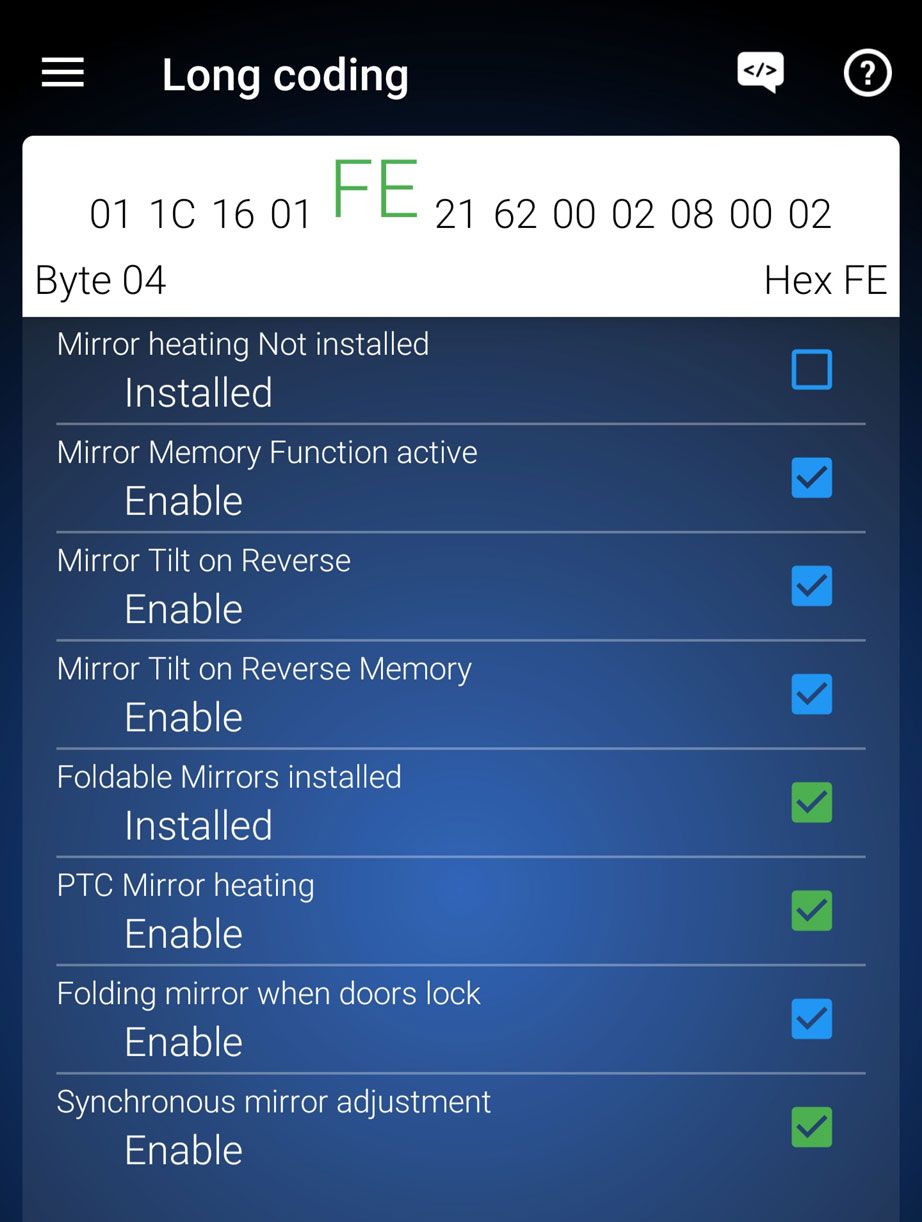
This Audi S6 came to AutoUpgrades after the owner upgraded from standard non-folding mirrors to genuine power-folding mirror assemblies. While the hardware installation was completed successfully, the vehicle required professional diagnostic coding to integrate the new components correctly into the car’s control modules.
Without proper coding, features such as mirror folding, memory positioning, and comfort functions remain inactive or trigger fault messages. Our role was to ensure the retrofit behaved exactly as it would if installed at the factory.
OEM-Level Audi Diagnostic Coding and Integration
Audi diagnostic coding involves accessing and configuring multiple control units within the vehicle, including body control, door modules, convenience systems, and gateway communication. Each module must be coded to recognise the new hardware and understand how it interacts with existing systems.
On this Audi S6, we performed the necessary coding adaptations to enable power-folding mirrors and ensure correct communication with memory, locking, and comfort systems. All changes were validated to confirm fault-free operation and full system compatibility.
The result was seamless factory-level behaviour. Mirror folding operates exactly as intended, memory positions function correctly, and no warning messages or software conflicts are present.

Unlocking Hidden Audi Features with Diagnostic Coding
Audi diagnostic coding is not limited to retrofit integration. Many vehicles leave the factory with features disabled for regional, regulatory, or trim-level reasons. With the correct diagnostic approach, these features can often be safely activated.
Common Audi feature activation requests include power-folding mirrors, comfort closing via remote, digital speed display, daytime running light behaviour, ambient lighting configuration, and system adaptations after component replacement.
By using manufacturer-grade diagnostic tools and validated coding procedures, these features can be enabled without compromising system stability or vehicle reliability. Every change is performed within factory parameters, ensuring the vehicle continues to operate as Audi intended.

Professional Diagnostic Coding for European Vehicles
AutoUpgrades provides professional diagnostic coding and feature activation for a wide range of European vehicles that share similar control architectures. This includes Audi, BMW, Volkswagen, Skoda, Seat, Lamborghini, and Bentley.
Each diagnostic coding session is approached with the same discipline used in OEM development environments. Control units are accessed correctly, coding changes are verified against factory behaviour, and full system scans are performed to confirm fault-free operation.
This approach ensures that retrofitted components integrate cleanly, hidden features operate predictably, and the vehicle retains its original refinement and reliability.
Experience Audi Diagnostic Coding Done Properly
If you have fitted new components, carried out a retrofit, or want to explore your vehicle’s hidden capabilities, professional Audi diagnostic coding is essential. Incorrect or incomplete coding can lead to faults, unpredictable behaviour, and long-term system issues.
AutoUpgrades offers OEM-level diagnostic coding and feature activation developed with proper engineering methodology and real-world validation.
This level of diagnostic coding is particularly important on modern Audi platforms where multiple control units share responsibility for comfort, safety, and driver assistance systems, and changes must be coordinated correctly across the entire vehicle network.
Audi diagnostic coding is especially critical after hardware changes such as mirror retrofits, camera replacements, steering wheel upgrades, or control module swaps. Without correct coding, vehicles may store fault codes, disable related systems, or behave inconsistently across different driving modes.
The result is factory-correct functionality, seamless integration, and an Audi that behaves exactly as it should, because it is configured the right way.